5.28.26
Virgin Galactic and Nonprofit Operation Period Announce First-Ever Spaceflight to Study Menstruation in Microgravity
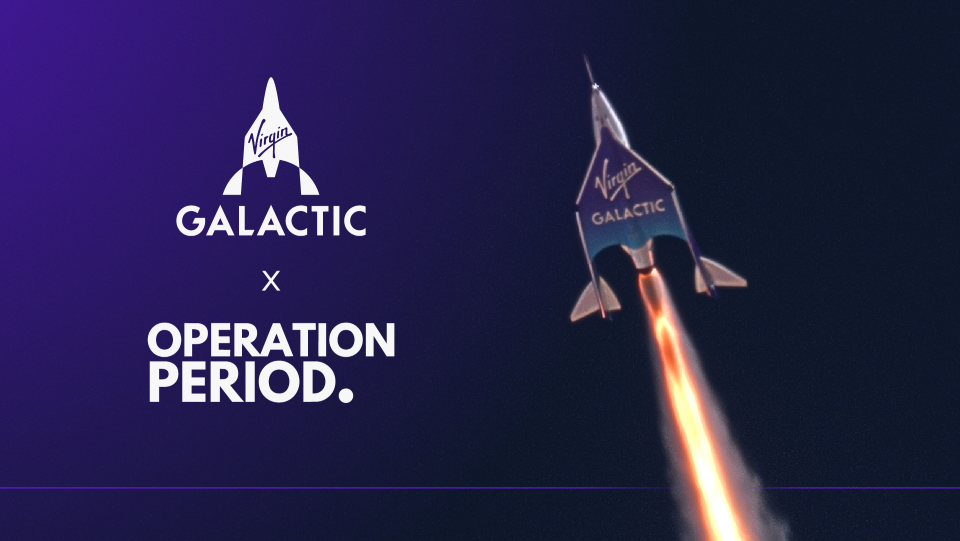
Virgin Galactic and Operation Period are proud to announce Operation Period-01 (OP-01), the first-ever spaceflight dedicated to studying menstruation in microgravity. The groundbreaking research, planned to be conducted on a 2027 Virgin Galactic suborbital research flight, is expected to be led by engineer and researcher Manju Bangalore and aerospace engineer and pilot Priya Abiram.
The mission represents a landmark moment at the intersection of commercial spaceflight, women’s health, and scientific innovation, and is intended to help to address a longstanding gap in aerospace and medical research.
Virgin Galactic believes OP-01 will also further establish Virgin Galactic as a leader in commercial space research, and will be the only human-tended suborbital research platform of its kind. With its prototype spaceship, VSS Unity, Virgin Galactic flew seven suborbital research missions. Virgin Galactic’s next-generation spaceships are expected to extend this record of success, with the goal of enabling humans and research payloads to reach microgravity on more frequent and accessible flights.
A Critical Research Gap, No Longer Ignored
With human spaceflight progressing rapidly over the last several decades, researchers have studied bone density, cardiovascular function, muscle atrophy, sleep cycles, and the psychological impacts of space travel. Even as more than 750 people have traveled to space, including more than 100 women, menstruation has never been methodically studied in microgravity. OP-01 is expected to change that.
The mission, developed through Operation Period’s Redshift Lab initiative, is designed to investigate how microgravity impacts menstrual physiology and hormonal health, and search for greater insight into how space travel may affect individuals who menstruate.
“This mission is about more than a scientific first, it’s about correcting a fundamental design gap,” said Manju Bangalore, engineer, researcher and founder of Operation Period. “Human spaceflight has historically been built around a narrow definition of the human body. We are working to expand that definition and ensure that future space exploration reflects the full diversity of human experience.”
The mission’s research has potential implications not only for future astronauts, but also for healthcare innovation on Earth, from reproductive science to chronic conditions that remain under-researched and underfunded.
Advancing Human-Tended Research in Space
Virgin Galactic’s research platform is uniquely designed to support human-tended scientific missions, allowing researchers to accompany experiments directly and interact with payloads during spaceflight. That capability is increasingly important as the space industry evolves beyond demonstration missions and toward repeatable scientific applications with real-world impact.
“Enabling researchers to accompany and interact with their work in real time is a powerful advancement for scientific discovery,” said Amber Favaregh, director of system analysis and research at Virgin Galactic. “This mission reflects the kind of forward-looking research that will be essential as we expand human presence in space and ensure that future exploration is inclusive by design.”
As the only offering of its kind today, Virgin Galactic’s suborbital research platform is designed to enable a new category of agile, accessible, and human-centered space research — creating opportunities for institutions, innovators, and researchers to pursue experiments that have historically been difficult to access through traditional space programs.
Making Space for Everyone
At its core, OP-01 is also about representation. Both Bangalore and Abiram have built careers asking a central question: what happens when systems are designed without accounting for half the population?
Their work emphasizes engineering precision, reproductive health, and human-centered design, challenging longstanding assumptions about who space research serves and what scientific questions are prioritized.
Their mission also carries broader cultural significance. Bangalore and Abiram are expected to become among the youngest South Asian women to travel to space, helping expand representation in aerospace and STEM, while inspiring future generations of researchers, engineers, and explorers.
A New Era of Human-Centered Discovery
As Virgin Galactic continues building the future of commercial human spaceflight, missions like OP-01 are anticipated to represent measured proof points of what this next era can make possible. The future of space research will not only be defined by where we go, but by the questions we choose to answer when we’re there.
Forward-Looking Statements
This communication contains forward-looking statements within the meaning of the Private Securities Litigation Reform Act of 1995. We intend such forward-looking statements to be covered by the safe harbor provisions for forward-looking statements contained in Section 27A of the Securities Act of 1933, as amended (the “Securities Act”) and Section 21E of the Securities Exchange Act of 1934, as amended (the “Exchange Act”). All statements contained in this communication other than statements of historical fact, including, without limitation, statements regarding our spaceflight dedicated to studying menstruation in microgravity, including the timing and implications thereof, our potential to be a leader in commercial space research and our plans to enable research payloads, and our objectives for future operations and growth plans, are forward-looking statements. These statements are neither promises nor guarantees, but involve known and unknown risks, uncertainties and other important factors that may cause our actual results, performance or achievements to be materially different from any future results, performance or achievements expressed or implied by the forward-looking statements, including the factors, risks and uncertainties included in our Annual Report on Form 10-K for the fiscal year ended December 31, 2025, as such factors may be updated from time to time in our other filings with the Securities and Exchange Commission (the “SEC”), which could cause our actual results to differ materially from those indicated by the forward-looking statements made in this communication. Any such forward-looking statements represent management’s estimates as of the date of this communication.